Tuesday, February 1, 2011

Contracts: Why? and How? #1

But why does a church and a preacher need a contract? We’re Christians aren’t we?  We’re honest aren’t we?  We trust each other don’t we?

My plan in the next few posts is to explain what I have learned from the University of Hard Knocks, whose school colors are black and blue and the school yell is: “OUCH!”  I have learned that contracts are not for dishonest people.  Contracts are to preserve and protect agreements made by dead people and forgetful people.

The first two congregations where I preached, I did not have a written agreement.  We talked about some things, omitted some important issues, and recorded nothing to which we could later refer.  When I took my first week off, to my dismay, I realized that we had not discussed vacations.  I assumed that every preacher received a week or two off each year with pay.   I returned from visiting family during Christmas and did not have a check for that week.  After some conversation, one elder said, “He didn’t do nothing.  Don’t give him nothing.”  The eldership remained united on that decision.

I discussed that with the next congregation and had a verbal agreement that I would have two weeks’ vacation each year with pay.  I had learned an important lesson:  don’t assume.

...to be continued...

Friday, December 31, 2010

This Church Needs Elders


[An email exchange]

Jerrie,

Our congregation is without elders. Without going into details, we are in desperate need of some teaching on church government.

I just completed my 1st year as minister of this congregation and feel I have built enough rapport with the members to begin speaking on this matter. However, I feel someone else may be more qualified than I am to speak on this subject.

Do you have any suggestions? Where do I start?
__________

I like to go slow in situations like this. I choose not to choose sides with people. If some people are doing wrong (and all are: 1 John 1:8), it is because they do not know what they are doing (Luke 23:34). If they do not know what they are doing, I surely do not know what they are doing. I try to find out what they are doing by asking questions to learn for my benefit – not to change them. If, in the process, I find out what they are doing, they may find out what they are doing and want to do something differently.

When people criticize other people in the congregation – especially leadership – I like to ask, “How long has it been that way?”. If the situation has been that way for a long time, I then like to find out, “Why do you like it that way?”. Their reply usually is, “I don’t like it that way.” But they do. They like it the way it is more that what it would take to change it.

In a group, when a situation is chronic (been that way for a long time), it is because the group has cooperated to bring it to its present condition and to keep it that way. If there is something wrong, there are biblical principles to correct a problem. It may be painful, but the solution is there. Generally, people like a dysfunctional position the way it is better than what it would take to change it. However, pain is not to be avoided. The gospel is death, burial, resurrection. People get excited about the resurrection. I do not find as much enthusiasm for crucifixion. But crucifixion must precede resurrection. In my last full-time work, I waited about two years to start directly addressing the conflict that had been in the church for at least a decade. During those two years, I was listening to tapes of the services and meetings, listening to people who were concerned, and asking questions to try to clear some of my confusion as to how they arrived at their present position.

As a preacher and a Christian, I try not to get in a hurry to go to the cross. Jesus was not crucified until He was ready – until He chose to die. I try to take a year or two in a new work to find out what is going on. Then I do not try to solve the problem. I try to enable the group to solve the group’s problem. That congregation will be there after I leave. They need to work out the solution to solve the disease that is troubling the church now and to learn to solve other problems that will surface in the future. The apostles did not solve the problems of the neglect of the Grecian widows. They led the congregation to select seven qualified men. They did and “the saying pleased the whole multitude.” It is easy to please people when they are doing what they think needs to be done (Acts 6:1-7).

Tuesday, November 30, 2010

Am I Normal?


Why is it helpful to know the process of transition? Many churches have found good preachers and many preachers have found a good work without ever hearing of Ending, The Neutral Zone, and The New Beginning. (See May 31, 2010 post.)

Knowing how things usually work helps me in a stressful situation not to feel weird. I can endure the pain of stress if I know it is normal to feel what I am feeling and to be going through the stages of a process.


I have developed a philosophy that has been helpful to me:


1. I have found that it is normal to be abnormal. If a normal day is: 72 degrees, clear sky, the wind is not blowing, all the family is well, all the appliances and cars are operating perfectly, my favorite teams are winning, and politics are going my way—I don’t have may normal days.


2. In an abnormal situation, I cannot make another person do anything. Often, I have people ask me, “Do you have everybody straightened out in the church where you are preaching?”. My answer is “NO!!! I am working on Jerrie Barber and he is giving me a fit. I haven’t started on the other people.” That eliminates a lot of stress.


3. In an abnormal situation, which is really normal—since it is normal to be abnormal—and I can’t make anyone else do anything, what is the best thing I can do right now to make things better? That may be difficult but the work is close to home.


One of my goals as an interim minister is to encourage people to see the principles of transition in their lives as we experience transition in the congregation.

Wednesday, November 17, 2010

Dalton’s 12-Year-Old-Trip


Recently we went with our fifth grandchild on our Grandparent-grandchild Twelve-Year-Old Trip. Someone gave us this idea about fifteen years ago and we have enjoyed it very much.


The year that each grandchild is twelve, we take him/her on a trip of their choosing (within 300 miles of Nashville). They choose where we eat and what we do during the four days we are gone.

Dalton, Jerrie Wayne and Terri’s son, will be twelve December 21. We took advantage of fall break and good weather to go to Pigeon Forge the week of October 11.

Dalton’s choices for the week were: Dollywood on Tuesday, Parrot Mountain on Wednesday, Sevierville church of Christ Wednesday night, Oconaluftte Indian Village in Cherokee, North Carolina Thursday. Thursday was also the main shopping day. We give the grandchildren money – half to spend for themselves and half to spend for others in their family. On the way back from Cherokee, we went to Clingman’s Dome. Friday morning we went to MagiQuest.


It was a great week. We are proud of Dalton, as we are of our other grandchildren. It was a delight to be with him.


Tuesday, August 31, 2010

“I Wish it Was the Way it Used to Be”

The previously discussed model of transtion is frustrating because it involves uncertainty and often pain. Many people would like to leave the land of Egypt, immediately enter the Promised Land, and skip the forty years wandering in the wilderness.

Mr. Bridges (author of previously discussed books on transition) says that when people get into the Neutral Zone, they often wish for “the way it used to be” and try to make it that way. Solomon warned against this: “Do not say, ‘Why were the former days better than these?’ For you do not inquire wisely concerning this” (Ecclesiastes 7:10, NKJV).

 
Trying to make it the way it was is like taking a bottle of Elmer’s glue in November, picking up the dead leaves from the ground, glueing them on the tree so it will be “the way it was.” It won’t work. However, if you can keep from freezing to death during the winter, spring will come, leaves will come back to the trees, and flowers will bloom. It will not be exactly like it used to be but it will be good and a new season of growth can come.

 In the preacher-church relationship, failing to recognize the process of transition and the new beginning may bring unfavorable comparison to the former preacher from the congregation and may hear the new preacher constantly referring to “the way we did it where I came from.”


Monday, May 31, 2010

Stages in Transition


There is a difference between change and transition. Change is something that happens which we may or may not choose. Transition is my response to change.

Change is from the outside. Transition is from the inside.

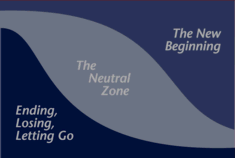
William Bridges outlines the three stages of transition (notice the books from the previous post):

1. Ending, losing, letting go. Transition begins with loosing something.

2. The new beginning. Eventually, something new will start.

3. The neutral zone. The key to understanding transition is this stage. It is the in-between time. The old is gone. The new isn’t fully operational. This is usually a time of confusion, disorientation.

Notice in the illustration that often one will be in all three stages at the same time. There will be the fear and sadness of the ending. There will be the excitement of the new opportunities. And on the same day will be confusion and wonder if anything will ever be normal again.


Saturday, April 3, 2010

Transition Books


William Bridges became an expert on transitions. His tapes and books have been helpful to me.


The first one I read was Transitions: Making Sense of Life's Changes. His entrance into the study and teaching was interesting: “I became interested in the subject of transition around 1970 when I was going through some difficult inner and outer changes. Although I gave up my teaching career because of those changes, I found myself teaching a seminar called, ‘Being in Transition.’” He states that change comes from the outside and is inevitable. Transition comes from the inside and is a choice.

The second book I read was Managing Transitions: Making the Most of Change. The first was the process and theory of transition. This one is a handbook of how to manage change in individuals and groups. A “mustard seed” I gained from this book was the Transition Monitoring Team – a committee in the organization that keeps the leaders aware of how the group is dealing with the change.

The third book, The Way of Transition: Embracing Life's Most Difficult Moments, describes how he dealt with the terminal illness of his wife, her death, his recovery, and eventual remarriage. He said there were times in this process he doubted whether anything he had been teaching was right. The pain of the “neutral zone” was great for him even though he had studied it and had been teaching the principles for years.